

Cold to warm: a Bolton terrace brought back
Every house we buy starts cold. It has stood empty, a bedroom corner is wet and the cellar smells of the ground. Ilan Nest buys terraced houses like that in the north of Bolton, brings each one back itself — dry, warm and safe — and then keeps it, as a home for one household. This page follows one house through that change, in the order it happens.
The pictures on this site are illustrations made for it. They are not photographs of houses we own.
Kept
- Room
- 19.0 °C
- Air
- 47 %
- Wall face
- 14.9 °C
- Dew point
- 7.4 °C
Wall dry, 7.5 °C clear of the dew pointDry · 7.5 °C clear
Cold and empty
The day a house like this becomes ours, it is quiet in the wrong way. Nobody has lived in it for a while, the heating has not run, and the walls have taken on the temperature of the street. Before we buy, we read it: the roof line and the chimney, any bulge in the brickwork, the lintels over the windows, the joists, the yard drain, and where the damp is and what kind it is.
Rising damp, rain getting in and condensation can look alike on a wall, and each has a different cause. Wiring and gas are tested, and asbestos surveyed, before any work.
Back to the brick
Before the dust come the notices. Work to a wall shared with a neighbour needs a party wall notice two months ahead; notifiable work is signed off through building control or by an installer registered to certify it; and as a company that builds, we take on a commercial client’s duties under the CDM Regulations.
Then the house is opened up. Failed plaster comes off, old cables and redundant pipes come out, and the fabric is back on show — brick, lath, joists, the flue. A stripped house tells the truth about itself, and most of what we decide next is decided here.
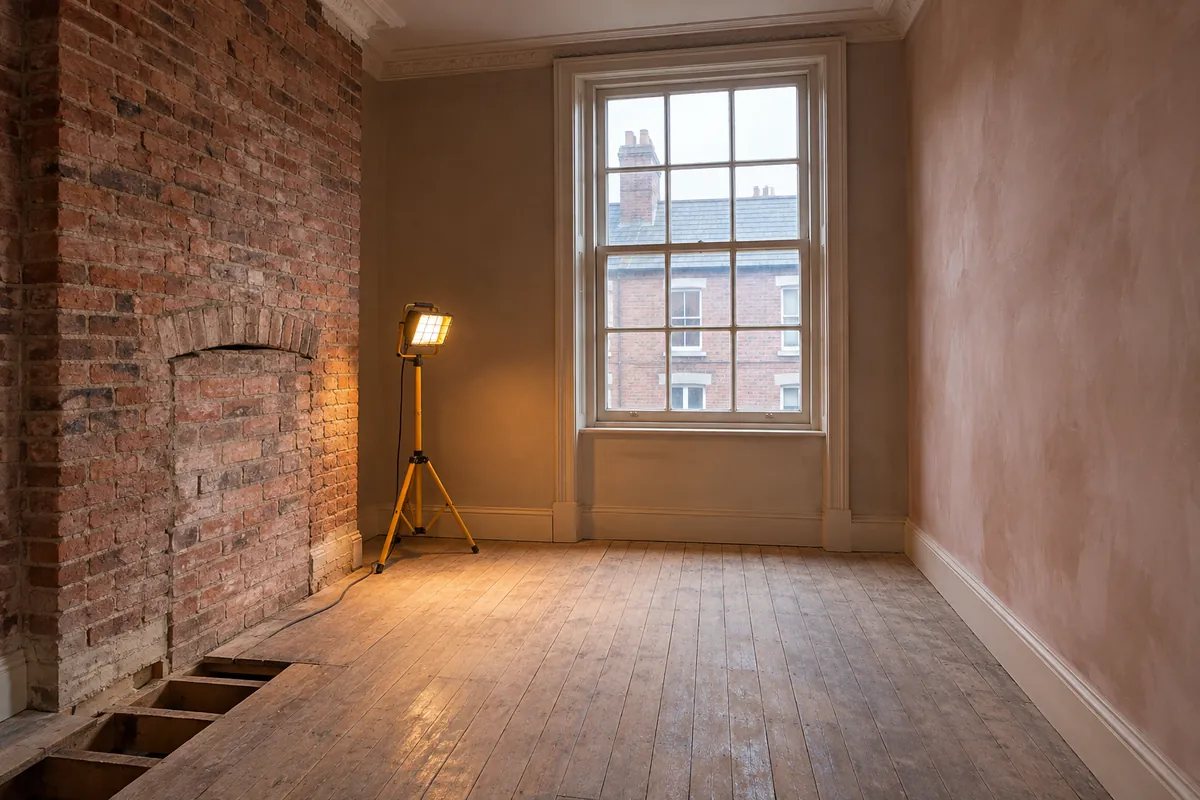
A stripped wall shows where the water has been.
Water stopped where it starts
Water is stopped where it starts, not covered up where it shows. A gutter that overflows, a downpipe that misses its gully, a sill that throws rain at the wall, ground built up against the brick, a cellar with its air bricks blocked — each is put right first.
Then the walls are left to dry, and drying takes weeks, not days: a solid nine-inch wall gets wet and dries through its own thickness. Where the brick or stone needs it, joints are made good in lime, which lets the wall breathe. Nothing goes back on a wall still giving water up.
The wall stops getting wet
A house makes water. Cooking, washing and drying clothes fill the air with it, and it has to leave by a route we choose, not through a cold wall. So each kitchen and bathroom gets an extract fan that runs while the room is in use and for a while after, each living room and bedroom gets background ventilation such as trickle vents, and the cellar is given back the air it was built to have.
Watch the back bedroom in the drawing. As the air moves, the dew point sinks below the wall’s face, and from here on water stops forming on that wall. The old single glass still mists at its foot on a cold night; the next stage deals with that.
Warmth kept in the rooms
Then the heat goes in, and stays in. Heating and hot water are installed by Gas Safe registered engineers. Draughts are closed at floors, skirtings and sashes, and windows are eased and repaired or, where one has to go, replaced with double glazing and a trickle vent. Insulation goes only where a solid wall can take it without trapping moisture behind it: a wall that cannot dry is worse than a cold one.
A warm room lifts the wall’s face well clear of the dew point, and the sash clears.
The same sum for a wall of your own: Will this wall get wet?
Lights on in every room
Before anyone moves in, the house is checked as a home: a gas safety check by a registered engineer, an electrical installation condition report on the wiring, an energy performance certificate, a smoke alarm on every storey, and a carbon monoxide alarm in any room with a fixed combustion appliance other than a gas cooker. Building control signs off the notifiable work.
Then a household moves in, on an assured periodic tenancy — the standard tenancy in England since May 2026 — with written terms.
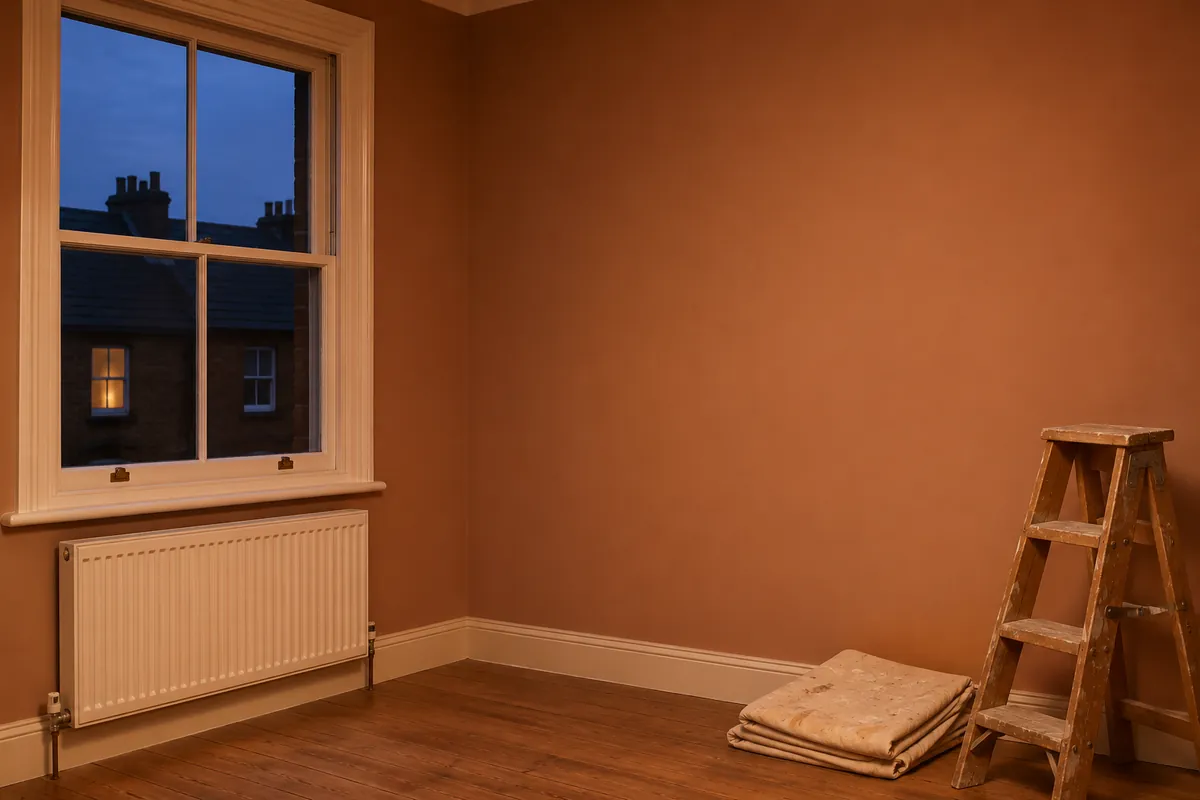
The job just done: dry glass, a warm wall, the dust sheet folded by the door.
Then we keep it
Keeping is the point. We plan for decades of the same house, not for one tenancy. Every year the gas is checked before the heating season; at least every five years the electrics are inspected and tested; alarms are tested, and replaced when they fail; gutters and gullies are cleared after the leaves come down and again in spring.
When something fails, the household tells us and we put it right. The round is laid out month by month on Keeping a home.
The buyer, the builder and the landlord are one company
The people who decide how a wall is dried are the people who will own that wall in thirty years.
Ilan Nest buys the house, runs the building work and keeps the home afterwards. There is no agent between the household and the owner. We do not act for other landlords, manage other people’s buildings or sell houses for anyone. Each home is let to one household, never as rooms, and selling a house we own is possible but unusual: keeping is the default.
We look in the north of the town — Halliwell, Smithills and Astley Bridge wards — where terraced houses are most of the street.
The streets themselves: Bolton terraces.
Selling a house? Put it forward
A terraced house you are selling in Halliwell, Smithills or Astley Bridge has its own page: four short steps and a reference to check it by. Anything else, write to homes@ilannest.space; a person reads it.