
Will this wall get wet?
Most damp in an old terrace is one of three things, and only one of them comes from the air of the room. This page explains the three, shows why a solid wall runs cold, and works out — from your own readings — whether water will form on a wall tonight.
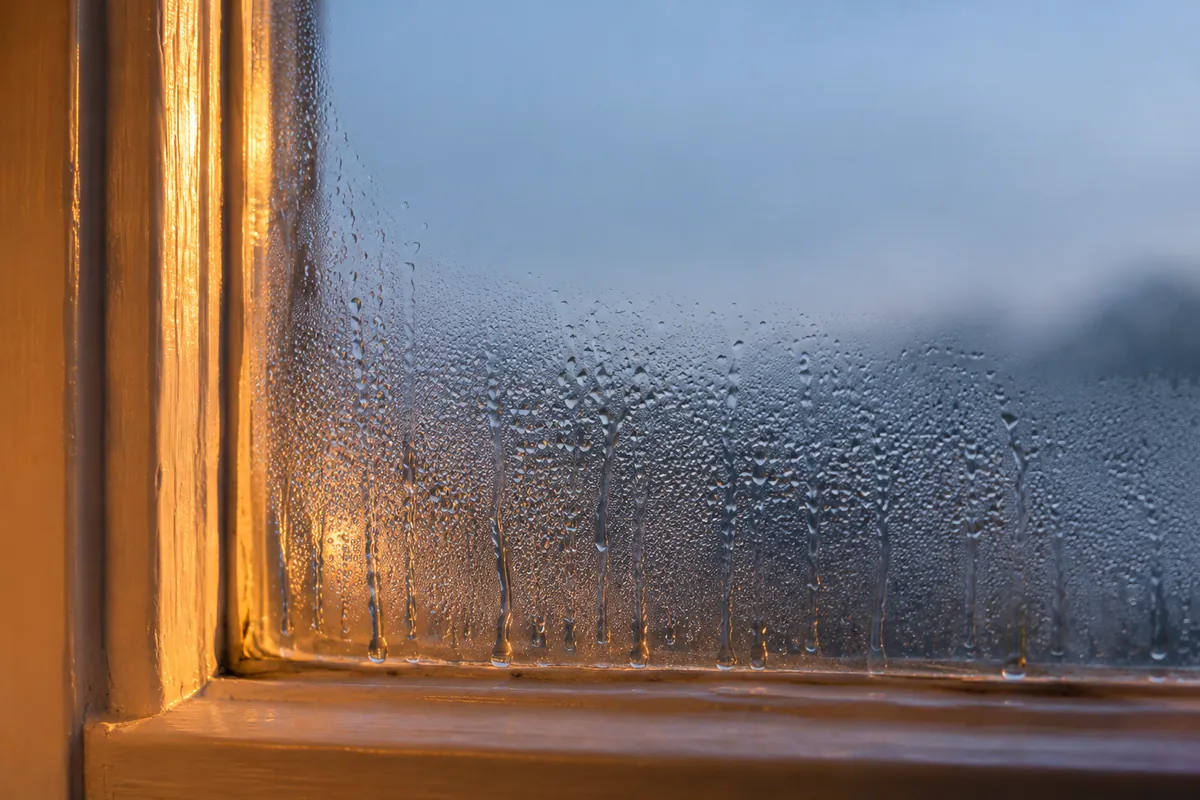
Water forms where a surface is colder than the air’s dew point.
Three ways water gets into a wall
Rising damp, rain getting in and condensation can leave the same dark patch on a wall. Each has a different cause, so each has a different cure, and treating the wrong one wastes a winter.
- Rising damp
- Moisture from the ground drawn up a wall, usually where the damp-proof course has failed, been bridged by raised ground, or was never there. It shows low down, often with a tide line.
- Put right by removing the bridge or the cause, then letting the wall dry.
- Rain getting in
- Penetrating damp: water through a defect — a blocked gutter, a downpipe that misses its gully, failed joints, a sill, a chimney. It shows near the defect and gets worse after rain.
- Put right by mending the defect, then drying.
- Condensation
- Water from the room’s own air, forming on a surface colder than its dew point: the glass first, then cold corners and the wall behind a wardrobe. It is worst in winter, in the morning, and where washing is dried indoors.
- Put right by moving air and steady warmth.
Why a solid wall runs cold
Most Bolton terraces have solid walls: nine inches of brick or stone, about 225 mm, with no cavity. Heat goes through a solid wall faster than through a cavity wall, so on a cold night its inside face sits closer to the outside temperature. The same wall gets wet and dries through its own thickness, which is why it has to stay open to vapour: a lining that traps moisture behind it can do more harm than the cold it keeps out.
How fast heat goes through is the wall’s U-value, in watts per square metre for each degree between inside and outside. An old solid brick wall is usually counted at about 2, an insulated wall well under 1, single glass nearer 6.
The dew point, and the wall’s face
Air holds water as vapour, and warmer air holds more. Cool the air of a room and at some temperature it can hold no more: that is its dew point. Any surface colder than the dew point gets wet.
A wall’s inside face is colder than the room by an amount set by its U-value and the difference between inside and outside. The check below works it out the standard way: face = room − 0.13 × U × (room − outside), where 0.13 m²K/W is the inside surface resistance used in U-value work. The dew point comes from the Magnus formula, from the room’s temperature and humidity.
Check a wall
Put in what a thermometer and a hygrometer say in the room, and the temperature outside. The wall and window figures start at values typical of each kind; they are not measurements of your house, so change them if you know better.
The wall stays dry; the glass will run with water.
- Dew point of the room’s air
- 11.3°C
- Wall’s inside face
- 14.2°C
- Glass, inside
- 7.6°C
- Air at the wall’s face
- 83%
- The wall’s face is 2.9 °C above the dew point.
- Right at its face the air is at 83 % — at or above the 80 % that mould-risk standards work to. Kept up for days, that is enough for mould to grow.
- With the same moisture in the air, the room would need to be about 18.8 °C to clear it.
- At 18.0 °C, bringing the room down to about 63 % humidity would clear it. Moving air is how humidity comes down: extract while cooking and washing, trickle vents open, clothes dried outside or in a vented dryer.
- The glass is the coldest surface in the room, so it gets wet first.
Dew point from the Magnus formula (a = 17.62, b = 243.12 °C). Face = 18.0 − 0.13 × 2.10 × (18.0 − 4.0) = 14.2 °C.
The check works out what your readings mean; it cannot see your wall. Its answers run in this page and nothing you type is sent anywhere. The 80 % mark is the surface humidity BS EN ISO 13788 uses for the risk of mould growth.
What changes the answer
- Drier air
- Extract fans run while cooking and washing and for a while after, trickle vents left open, lids on pans, clothes dried outside or in a vented dryer. Drier air brings the dew point down.
- Steady warmth
- A room heated in short bursts leaves its walls cold. Even, steady heat lifts the wall’s face, and with it the margin.
- A warmer wall
- Where a solid wall can take it, an insulating lining that stays open to vapour. Never one that traps water behind it.
- Air behind furniture
- A wardrobe hard against a cold outside wall makes the coldest, stillest corner in the room. A gap of a few centimetres lets air reach it.
Under the Housing Act 2004, damp and mould growth is one of the hazards a council can require a landlord in England to put right. We treat it as a fault in the building, with a cause to find and fix: in the houses we keep, a household that sees water on a wall writes to homes@ilannest.space and we come and look.